
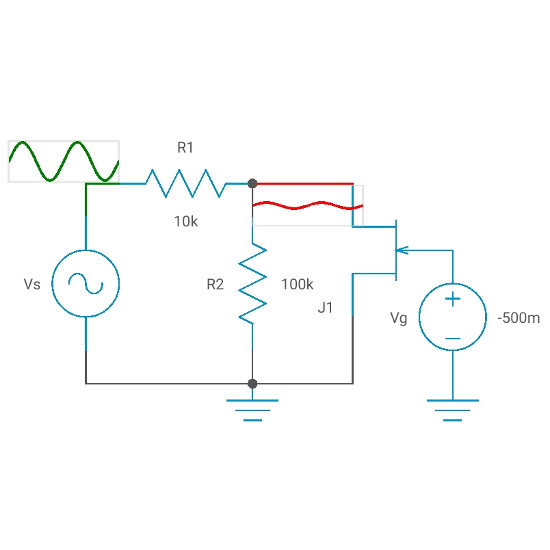

Introduction:
The following section will explain in details about the FET as a Voltage Variable Resistor-(VVR).
Jfet Gain
This can be done by adding two resistors to the gate circuit as shown to the right. This circuit functions as an excellent variable resistor. Note that this is an application of a JFET being used in the somewhat unusual linear regime as opposed to the more common saturated regime. JFET is operated in the constant current portion of its output characteristics for the linear applications. In the region before pinch off, where V D S is small the drain to source resistance rd can be controlled by the bias voltage V G S.The FET is useful as a voltage variable resistor (VVR) or Voltage Dependent resistor.
- The field effect transistor as a voltage controlled resistor We consider the use of a n-channel FET as a voltage controlled resistor where the resistance between the drain and source is controlled by the gate-source voltage. There are two distinct regions. In the Ohmic region1, the drain-to-source current, I DS, depends on the gate-to-source.
- A voltage-controlled resistor (VCR) may be defined as a three-terminal variable resistor where the resistance val-ue between two of the terminals is controlled by a voltage potential applied to the third. For a junction field-effect transistor (JFET) under certain operating conditions, the resistance of.
FET as a Voltage Variable Resistor-(VVR):
Fet As Variable Resistor Schematic
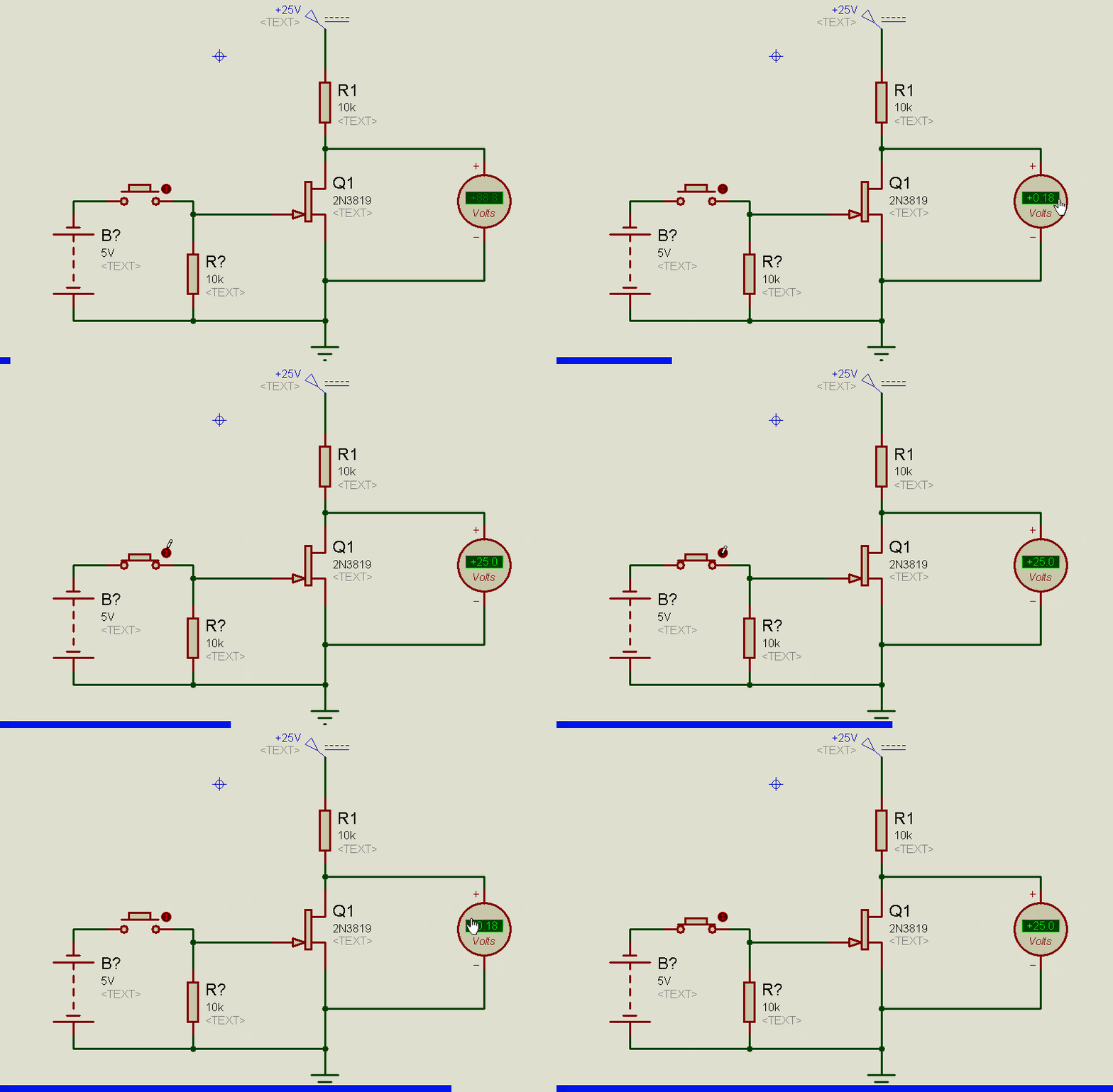
Jfet As Variable Resistor Code
- FET is a device that is usually operated in the constant-current portion of its output characteristics.
- But if it is operated on the region prior to pinch-off (that is where VDS is small, say below 100 mV), it will behave as a voltage-variable resistor (WE).
- It is due to the fact that in this region drain-to-source resistance RDS can be controlled by varying the bias voltage VGS.
- In such applications the FET is also referred to as a voltage-variable resistor or volatile dependent resistor.
- It finds applications in many areas where this property is useful.
- Figure shows the drain characteristic curves for a 2N 5951 in the ohmic region (i.e. for low VDS).
- From the characteristic curve it can be seen that RDS varies with VGS. For example, when VGS = 0, RDS = 133 ohm and when VGS = – 2 V, RDS = 250 ohm.
- Because of this a JFET operating in the ohmic region with small ac signals acts as a voltage-controlled resistance.
- Note that the drain curves shown in figure, extend on both sides of the origin.
- This means that a JFET can be employed as a voltage-variable resistor for small ac signals, typically those less than 100 mV.
- When it is employed in this way, it does not require a dc drain voltage from the supply. All that is required is an ac input signal.